
Your Garage Door Springs Are Working Harder Than You Think
Every time you open and close your garage door, the springs do the heavy lifting — literally. A standard garage door can weigh anywhere from 130 to 350 pounds or more, and the springs are responsible for counterbalancing all of that weight. Without them, your garage door opener couldn't move the door on its own, and lifting it manually would be nearly impossible.
Most homeowners in Fair Oaks don't think about their garage door springs until something goes wrong. But springs have a finite lifespan, and when they fail, it's usually sudden, loud, and inconvenient. The good news is that failing springs almost always give warning signs before they snap. If you know what to look for, you can schedule a replacement on your terms instead of dealing with an emergency.
How Long Do Garage Door Springs Last?
Garage door springs are rated by cycle life. One cycle equals one full open-and-close of the door. Standard torsion springs are typically rated for around 10,000 cycles, while high-cycle springs can last 25,000 to 50,000 cycles or more.
For the average household that opens and closes the garage door four times a day, a standard spring will last roughly seven years. If your household uses the garage door more frequently — as a main entry point, for example — that lifespan shrinks considerably.
Here in the Sacramento region, temperature swings between hot summers and cooler winters can also contribute to metal fatigue over time, potentially shortening the life of your springs.
7 Warning Signs Your Garage Door Springs Are Failing
1. The Door Feels Heavier Than Usual
Try this simple test: disconnect your garage door opener by pulling the emergency release handle, then manually lift the door about halfway. A properly balanced door with healthy springs should stay in place on its own. If it feels unusually heavy, slides back down, or is difficult to lift, your springs are losing tension and nearing the end of their life.
2. The Door Opens Unevenly or Crooked
If your garage door tilts to one side as it opens or closes, one of your springs may be weaker than the other. This is especially common on double-car garage doors that use two springs. When one spring weakens faster, the door pulls unevenly, which puts stress on the tracks, cables, and opener.
3. You Hear Loud Squeaking or Grinding
Some noise during operation is normal, but a sudden increase in squeaking, popping, or grinding sounds can indicate that the springs are straining under load. While lubrication can help reduce noise in healthy springs, persistent loud sounds often point to metal fatigue or coils that are starting to separate.
4. Visible Gaps in the Spring Coils
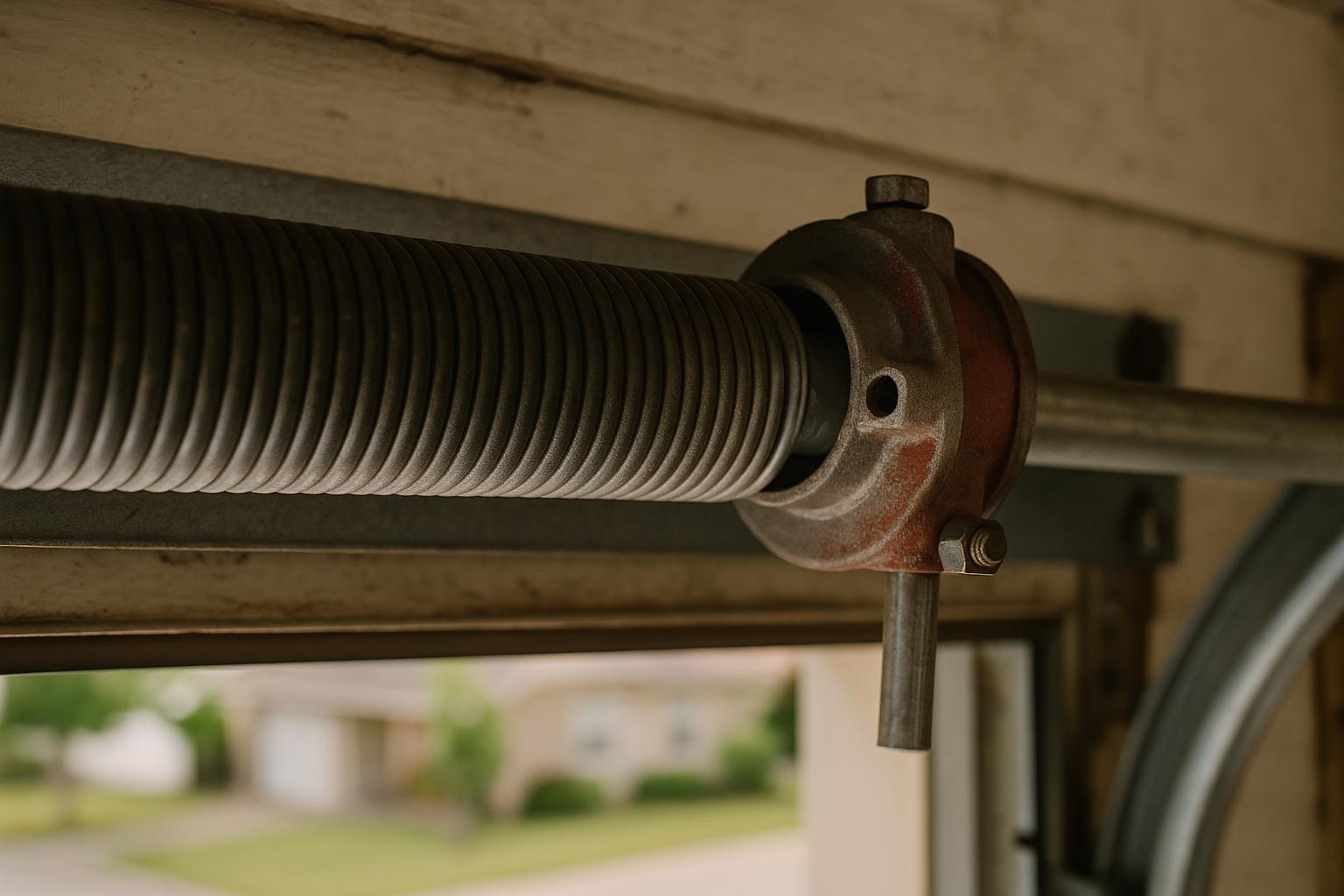
Take a look at your torsion spring, which is mounted on a metal shaft directly above the door opening. A healthy spring has tightly wound coils with uniform spacing. If you notice a visible gap or separation between the coils — even a small one — the spring has likely already partially broken or is on the verge of snapping.
5. The Opener Struggles or Stops Mid-Cycle
When springs lose their counterbalancing power, your garage door opener has to work much harder to lift the door. You might notice the opener straining, moving the door more slowly, or stopping partway through the cycle. Running your opener under this extra load can burn out the motor prematurely, turning a spring replacement into a much more expensive repair.
6. The Door Slams Shut Quickly
Healthy springs control the speed of the door as it closes. If your garage door drops faster than usual or slams to the ground when closing, the springs aren't providing enough resistance. This is a safety concern, especially for households with children or pets in Fair Oaks neighborhoods where the garage often doubles as a play area or workspace.
7. Rust or Corrosion on the Springs
Inspect your springs for visible rust. While our climate in the Fair Oaks and greater Sacramento area is relatively dry, moisture from morning dew, rain, and seasonal humidity can still cause corrosion over time. Rust weakens the metal and increases friction between the coils, both of which accelerate wear and raise the risk of a sudden break.
What Happens When a Garage Door Spring Breaks?
When a spring snaps, you'll likely hear a loud bang that sounds like a gunshot or a firecracker going off inside your garage. After that, your garage door probably won't open — or if it does, it will be extremely heavy and dangerous to operate.
A broken spring can also cause:
- Cable damage — When a spring breaks, the cables can unwind or snap, creating additional hazards.
- Door off track — The sudden imbalance can cause the door to jump off its tracks.
- Opener damage — Attempting to open the door with a broken spring puts extreme strain on the opener motor.
- Safety risks — A falling or uncontrolled door is a serious injury hazard.
Why You Should Never Replace Garage Door Springs Yourself
We understand the DIY spirit — many Fair Oaks homeowners are handy and capable. But garage door spring replacement is one job that should always be left to trained professionals. Here's why:
- Extreme tension: Torsion springs are wound under tremendous force. A spring that releases unexpectedly can cause severe injuries or even death.
- Specialized tools required: Proper replacement requires winding bars, clamps, and other tools that most homeowners don't have.
- Precise calibration: Springs must be wound to the exact tension for your specific door weight and size. Incorrect tension leads to premature failure or unsafe operation.
- Paired replacement: When one spring breaks, the other is usually close behind. A professional will assess whether both springs should be replaced to avoid a repeat failure in a few weeks.
Proactive Maintenance Extends Spring Life
You can get more life out of your garage door springs with some basic preventive care:
- Lubricate the springs every three to four months with a silicone-based garage door lubricant. This reduces friction and helps prevent rust.
- Schedule annual maintenance with a professional who can inspect the springs, test door balance, and catch early signs of wear.
- Address problems early. If you notice any of the warning signs listed above, don't wait. A planned spring replacement is far less disruptive and costly than an emergency repair.
When It's Time, Call a Local Pro You Can Trust
If your garage door springs are showing signs of wear, don't wait for them to snap. At Fair Oaks Garage Door Specialists, we handle spring replacements for homeowners across Fair Oaks, Citrus Heights, Orangevale, Carmichael, Rancho Cordova, and Folsom. We carry a wide range of spring sizes on our trucks so most repairs can be completed in a single visit.
Whether you need a routine spring replacement or you're dealing with a spring that's already broken, we're here to help. We offer same-day and emergency service so you're never stuck with a garage door that won't open. Give us a call, and we'll get your door back in safe, reliable working order.