
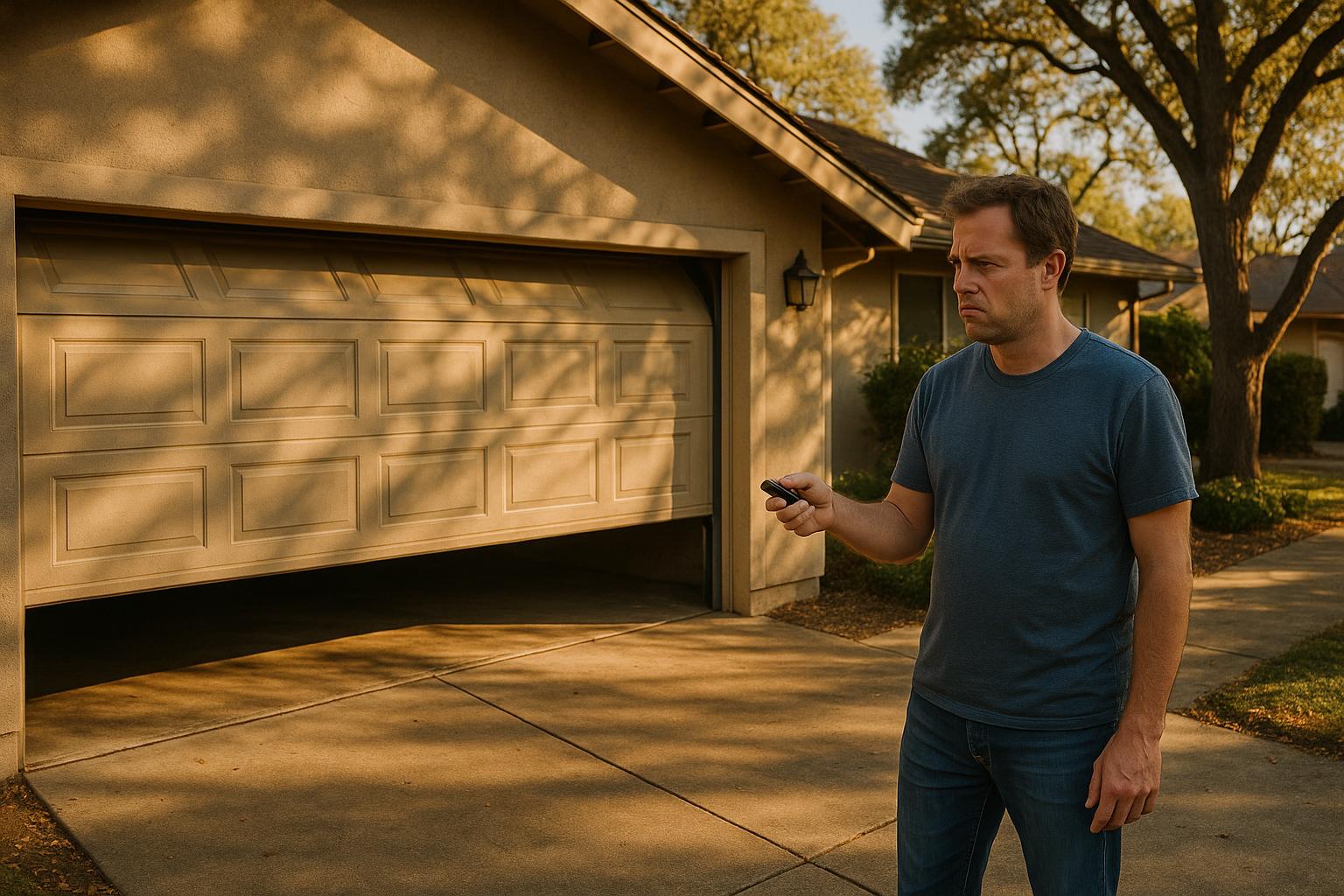
You're Running Late and Your Garage Door Won't Budge
It's a scenario that plays out in driveways across Fair Oaks more often than you'd think. You press the button on your garage door opener, hear a click or a hum — and nothing happens. Or maybe the door lifts a few inches and stops. You're already running behind, and now you're stuck.
A garage door that won't open in the morning is one of the most common calls we get at Fair Oaks Garage Door Specialists, especially during the colder months. The good news is that some causes are simple enough to diagnose yourself. The bad news is that others require professional attention. Let's walk through the most likely culprits so you know what you're dealing with.
Check the Obvious Things First
Before you assume the worst, rule out the basics. You'd be surprised how often the fix is something simple:
- Dead remote batteries. If your wall-mounted button works but your remote doesn't, swap the batteries. This is the number one "false alarm" we see.
- The door is locked. Many garage doors have a manual lock mechanism on the inside. If someone accidentally engaged it, the opener will strain against a locked door and fail to lift it.
- The opener is unplugged. It sounds too simple, but power cords get bumped, especially if you use your garage as a workshop or storage area.
- A tripped circuit breaker. Check your electrical panel. If the breaker for your garage has tripped, reset it and try again.
If none of these solve the problem, it's time to look a little deeper.
Temperature-Related Issues
Fair Oaks doesn't get extreme winters, but morning temperatures in the Sacramento region can dip into the 30s during December and January. Cold weather affects your garage door system in several ways:
- Metal contracts in the cold. Springs, tracks, and rollers all tighten up when temperatures drop. This increases friction and can make the door too heavy for an aging opener to lift.
- Lubricant thickens. The grease on your springs and rollers becomes stiff in cold weather, creating resistance. A silicone-based lubricant designed for garage doors handles temperature swings much better than standard grease.
- Weatherstripping sticks to the ground. If your garage floor gets damp overnight, the rubber seal at the bottom of the door can freeze or bond to the concrete. Gently breaking the seal by pulling the emergency release and lifting the door manually usually solves this.
If cold mornings are a recurring problem, a seasonal maintenance visit can address most of these issues before they leave you stranded.
The Opener Motor Runs But the Door Doesn't Move
When you hear the motor running but the door stays put, the problem is usually one of two things:
Stripped Gear in the Opener
Most chain-drive and belt-drive openers use a nylon gear inside the motor housing. Over time, this gear wears down and eventually strips. When it does, the motor spins freely without engaging the drive mechanism. You'll hear the motor humming, but the chain or belt won't move. This is a common repair, and replacing the gear is far more affordable than replacing the entire opener.
Disconnected Emergency Release
Every garage door opener has a red emergency release cord that disconnects the door from the opener carriage. If this has been pulled — intentionally or accidentally — the opener will run without moving the door. Simply reconnect the trolley to the carriage by pulling the cord toward the door and cycling the opener. The trolley should snap back into place.
The Door Starts to Open and Then Stops
If your garage door lifts partway and then stops or reverses, the issue is often related to the opener's force or travel settings, but it can also point to more serious mechanical problems:
- Broken torsion spring. A broken spring removes the counterbalance that supports the door's weight. The opener simply can't lift a 150- to 250-pound door on its own. Look at the springs above the door — if you see a visible gap or separation, do not attempt to operate the door. Call a professional immediately.
- Obstructed or misaligned tracks. Inspect the vertical and curved sections of the tracks for dents, debris, or rollers that have jumped out of the track. Even a small obstruction can cause the door to bind.
- Worn cables. The lift cables run from the bottom brackets of the door up to the spring assembly. If a cable is frayed, loose, or has come off the drum, the door will lift unevenly or not at all. Like springs, cables are under extreme tension and should only be handled by a trained technician.
Safety Sensor Problems
Modern garage door openers manufactured after 1993 are equipped with photoelectric safety sensors near the base of the door tracks. These sensors prevent the door from closing on a person, pet, or object. However, they can also prevent the door from operating correctly if they malfunction.
Common sensor issues include:
- Misalignment. If one sensor gets bumped, the two units can no longer "see" each other. Most sensors have a small LED light — if it's blinking instead of steady, the sensors are out of alignment. Gently adjust the sensor until the light holds steady.
- Dirty lenses. Dust, cobwebs, and moisture can block the infrared beam. A quick wipe with a clean cloth often restores normal operation.
- Damaged wiring. The low-voltage wires running from the sensors to the opener can get nicked by yard tools, chewed by rodents, or degraded by sun exposure. If cleaning and realigning don't work, the wiring may need to be inspected.
When to Call a Professional
Some garage door problems are safe to troubleshoot on your own — dead batteries, tripped breakers, dirty sensors. But anything involving springs, cables, or the door coming off its tracks is a job for a trained technician. These components are under high tension and can cause serious injury if handled incorrectly.
Here's a good rule of thumb: if the fix requires tools beyond a screwdriver and a stepladder, or if you're unsure what's wrong, call for help. A quick diagnostic visit is always cheaper than an emergency room trip.
Don't Let a Stuck Door Ruin Your Day
A garage door that won't open is more than an inconvenience — it can disrupt your commute, compromise your home's security, and leave your vehicle trapped. If you're dealing with a stubborn door in Fair Oaks or the surrounding communities like Citrus Heights, Orangevale, or Carmichael, Fair Oaks Garage Door Specialists can help. We offer same-day service for most repairs and emergency service when you need us fast.
Whether it's a worn-out gear, a broken spring, or a sensor that needs adjusting, we'll diagnose the problem quickly and get your door moving again. Give us a call — we'd rather fix it right than have you forcing it open every morning.